You know it’s time for a holiday when…

Today someone stopped me on the street to ask whether I could tell her how to get to a certain intersection. I gave her directions, she thanked me, and we went our separate ways. Now, in my defense, this all happened in French, which made my brain work a little harder than it usually has to, but as I walked away, my first thought was to mark this down as a reference interaction (at McGill, we would call it a “directional” question). Clearly I’m stuck in work mode – I’m sure glad the holidays are almost here!

In other news, there’s an article about the CODE fundraiser up on the ABQLA website:

And I have a new post up on the Re:Gen blog:

Have a great holiday, everyone!

More lists of advice for students

If there’s one thing library bloggers love writing, it’s lists of advice. Here are a couple of recent ones that students might find useful:

And let me assure you, I’m not posting this just so I can end up on someone’s list of lists of lists of advice. ;)

Talking about blogs and Twitter at John Abbott College

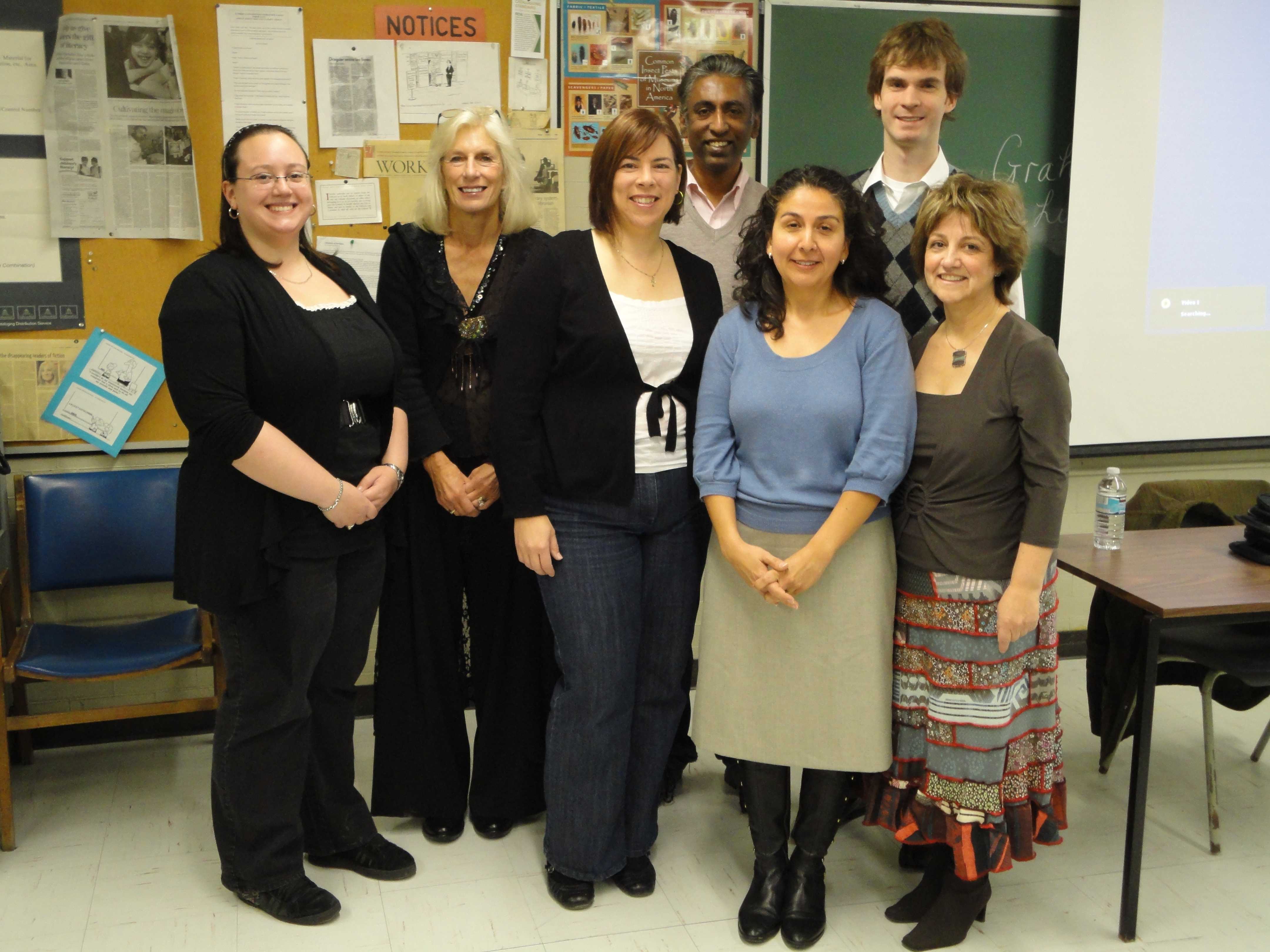
Here I am with the organizers of my presentation at John Abbott, wearing my favourite sweater vest

I had been meaning to write a post about the presentation I gave at John Abbott College’s Information and Library Technologies department last month, but it looks like the ABQLA beat me to it. I’ve given this presentation a couple of times before, but I was very happy to have been invited to speak at John Abbott. The students had some very good questions and seemed to be quite interested in what I had to say.

Read all about it from the ABQLA:
Recent Presentation at John Abbott College: Join the Conversation in the Blogosphere

And if you’re interested, you can also check out my slides.

Advice to a library school student from One Big Library

Whenever I come across really good advice for library school students, I like to post it on here, so today I want to share something I came across (thanks, Amy!) from One Big Library: Advice to a library school student.

The best advice anybody ever gave me when I was finishing library school and looking for a job was “look at all your options and choose the most challenging one. If it scares you, like you think maybe you won’t be up to the challenge, you’re on the right track and should go for it.” If you don’t feel challenged now, you’re right to be looking elsewhere (especially if you’re young or don’t otherwise have lots of obligations to other people and can freely look around).

When I was in school I found there was a lot of handwringing amongst my classmates about whether they would be up to the challenge of professional positions. When I started at the Howard Ross Library of Management, I was a bit concerned (read: terrified) by my lack of knowledge about anything business-related. But I saw the position as a challenge, and guess what – I’ve learned a whole lot, both in terms of business information and in terms of librarian skills that will be applicable to any job I may have in the future. So what do I think about scary challenges? I say bring them on!

As always, click through for the rest of the article – you’ll be glad you did.

New semester, new challenges

So I’m finally starting my first fall semester as a bona fide liaison librarian. Well, maybe “starting” isn’t the right way to put it, since students are already writing midterms. But the library is full of people, whether they’re studying for exams, asking for help with their assignments, or using the group study rooms to work on their group projects.

I’ve been doing plenty of information literacy and reference work, but here’s what else has been keeping me busy:

  • As the current president of the CLA Montreal Chapter, I’ve been working hard with the president elect and past president to line up some great events for the coming year. Anyone in Montreal should join us on Wednesday for our first event of the year in our Salon des
    Bibliothécaires series.
  • I’m also the Awards & Honours Chair of the SLA Eastern Canada Chapter, so if anyone would like to nominate an SLA ECC member as Member of the Year, please let me know.
  • I have a new partner in the Professional Partnering Program. Although I had the option of keeping Christie as my partner, she’s now working part-time at my branch, so I can’t stop her from bugging me I know we’ll still be in touch. My new partner couldn’t make it to the kick-off this past week, but I was fortunate enough to meet her at the ABQLA kick-off the week before – good thing we were all wearing name tags, or I never would have known it was her!
  • I’ve been writing for the Re:Generations blog for the past year, but now I’m officially on the committee! I’m super excited to be working with this great group of people, and we’ve even put in a couple of proposals for CLA 2011 sessions. You can check them out at the CLA’s list of proposals – ours are numbers 69 and 158.
  • Our weeding project (which I discussed briefly on the Re:Gen blog) has become more urgent than I had anticipated, so it looks like I will be spending a lot of time determining which of our print journals are also available online from a reliable source and evaluating the print books that haven’t circulated in the past decade. Fortunately, weeding is an activity I think is essential to any library, and I would even go so far as to say I enjoy working on it.

Of course there’s more, but that’s enough about me for now. Happy Thanksgiving to all of my fellow Canadians, and I hope everyone is having a great fall season.

Library tourism

I recently traveled to the UK for a good friend’s wedding. I’m not telling you this because I want to turn this blog into a LiveJournal-style diary; I’m telling you so we can all have a little laugh about what a librarian considers to be the most important tourist destinations when traveling. This post is sort of a follow-up to the one I wrote on the Re:Gen blog before leaving for my trip.

After touching down in Belfast, we spent our first three nights in Dublin. Unfortunately, the National Library of Ireland was closed when we tried to visit (late on a Saturday afternoon, oops!), but we saw two other libraries while we were there. The first was the Chester Beatty Library, which was recommended to us by someone on the train from Belfast to Dublin. The exhibitions were quite interesting, but we were disappointed to find it to be more of a museum than a library. There is no circulating collection, and although scholars can use the reading room to consult the collections (mainly old manuscripts and rare books), the emphasis seems to be on the exhibitions.

Two commenters on my Re:Gen post insisted that we also visit the Trinity College Library, and we were certainly not disappointed. Although the most highly promoted aspect of the library was their exhibition of the Book of Kells (I suppose this was how they justified the entrance fee), we were most fascinated by the Long Room, which contains row upon row of rare books.

Back in Belfast, we went to the Belfast Central Library, which we found to be similar to many public libraries in North America. What surprised us (and we found this to be the case across the city, not just at the library) was Belfast’s continuing interest in the Titanic. The ship was built in Belfast, and the library had a display of books and newspaper articles about it (we also saw ads for a Titanic walking tour). This apparent pride completely baffled us, since the Titanic was, as the kids would say today, an epic fail.

Next up was the Linen Hall Library. Founded in 1788, it’s the oldest library in Belfast, though you might not guess it from its current modern building. There we saw an interesting exhibition on the Troubles, which involved 70 political posters.

Finally, on our brief visit to London, we were able to spend a couple of hours at the British Library. We first noticed the lively square outside, where ping pong tables were freely available to the public, and a variety of people drank tea outside a cute little cafe. Once inside, we thoroughly enjoyed the exhibition on maps, with a focus on historic maps that were designed to be displayed on walls as art or propaganda (as opposed to maps designed for navigation). We discovered that we could not access the reading rooms without a member card, but it turned out that the process for acquiring a card was painless and efficient, so we were able to register and then enter the reading rooms. The collection is mainly held in closed stacks, but we were impressed to see the vast reading rooms filled with researchers. The Business & IP Centre was especially interesting, as it featured displays of inventions created by entrepreneurs who had made use of British Library resources when either creating or patenting their work.

Do you visit libraries while on vacation? What do you think is the best tourist city when it comes to libraries?

Conference season is upon us

I recently attended the SLA conference in New Orleans, and it was an incredible experience. I want to remind everyone, students and professionals alike, that going to conferences is an invaluable opportunity for networking and learning more about the community. If you’re interested in hearing my thoughts on SLA 2010, check out my post on the Re:Generations blog (Re:Gen has other great conference posts as well).

Of course, you may not be able to travel as far as New Orleans (unless you already live near there), so keep your eyes peeled for local conferences. For those of us in Quebec, the ABQLA puts on an excellent conference each year in Montreal. Whether you take advantage of discounted student registration rates or work as a volunteer (which usually means avoiding registration fees altogether), you should absolutely make a point of fitting at least one upcoming conference into your schedule.

You’ll find the biblioblogosphere is already filled with conference tips, so I’ll refrain from adding more of my own, but I will suggest that you check out Stephen Abram’s tips. And as always, if you have questions for me, just ask.

Library school student power

Today I’d like to delve a little deeper into a topic I’ve briefly mentioned before on more than one occasion. I’m not sure whether students actually know about this; perhaps they’re completely in the dark, or perhaps they’ve been told but they can’t believe such an outrageous idea. At any rate, as far as I can tell, most students certainly don’t act as if they know about it. At its core, what it boils down to is this: library school students have power.

I can’t tell you whether this applies to students in other professional programs, or other Master’s programs, but I can certainly tell you that it doesn’t apply to most undergrad programs. Library school students are in a unique position to influence their peers and the profession as a whole, but they don’t seem to realize it. Here’s how I would describe this power:

  1. Professionals in the LIS community are not simply willing to listen to students; most of them are very much interested in hearing the student perspective.
  2. Library school professors are usually willing to change their classes based on student feedback.
  3. Students have a wide range of opportunities to set themselves apart from their classmates.

Before we get started, I’d just like to urge everyone to use this power for good, not for evil. Frankly, if your main goal in life is to hold power over other people, librarianship is the wrong field for you anyway. All of my suggestions should be fulfilling and add to your professional development in and of themselves; please don’t do any of these things just to feel powerful. Having said that, everybody wants to change the world, and it’s okay to make your voice heard.

Regarding point #1: librarians are notoriously nice people, so I can’t really blame a student who has a brief conversation with a professional and comes away saying, “well, of course he was nice to me. He’s nice to everyone. That’s his job.” But take it from me, professionals really are interested to hear what they’re teaching in school these days and we really are interested to hear fresh ideas. So how can a student get in touch with a librarian? I can think of a number of ways, some of which may be out of some people’s comfort zones, but there should be at least one that works for everyone.

  • Join a mentoring program, like McGill’s Professional Partnering Program. I know I keep mentioning this, but it’s really a no brainer: if there’s one available to you, sign up. And if not, start one on your own. This is a super low stress way to meet someone, since you know the professionals have volunteered because they’re interested. For bonus exposure, ask your classmates about their mentors and consider organizing a group event.
  • Attend events put on by professional associations. Later I’m going to urge students to become involved with their student chapters, but a great way to meet professionals is to go to events that aren’t designed specifically for students. For example, I’m involved with the Canadian Library Association Montreal Chapter, and we often organize informal social events. Students are encouraged to come to these events, and no one is treated differently than anyone else: professionals learn from students and vice versa. For bonus influence, start asking around to find out whether the chapter will be looking for new exec members after you graduate.
  • Start a blog. This is another piece of advice I’ve given before, but consider this: every time another blogger mentions your blog or quotes something you’ve written, you are influencing the biblioblogosphere. While I was a student, I got in touch with a number of librarians through my blog and formed some lasting professional relationships. And for every blogger who mentions your blog, there will probably be a bunch of professionals who read it, enjoy it, and don’t leave a comment. For bonus power, leave comments on other LIS blogs.
  • Find a professional you admire and contact them. This is where it gets a bit scary, and I’m afraid I can’t promise every librarian will want to be your best friend. You might be surprised, though, at the number of professionals who would be more than happy to spend some time telling you about what they do, or even showing you around their place of work. If there’s a particular library you’re interested in working at, get in touch with one of the librarians there. A good way is to look up the library’s website and find the email address of a librarian who has a job that looks interesting; just write to them explaining that you’re a student and asking whether you could meet with them to ask a few questions. For bonus points, make sure you have a few specific questions in mind when you actually do meet them, since some librarians may not have a good idea of what to tell you unless you ask.

Point #2 is fairly straightforward: if you don’t like the way a course is being taught, or if you have suggestions for how it could be improved, just tell your prof. Your best bet is to schedule a time to meet your prof in person, since this shows that you’re serious. Naturally, make sure your suggestions are constructive; don’t criticize anything unless you also suggest how it could be improved (this will serve you well in your professional life as well). At the very least, put in some serious thought when you fill out your course evaluations – profs read these comments and adjust their teaching based on them.

Point #3 mainly applies to having power over your own career path. As I briefly mentioned recently, many students choose to sit back and let library school happen to them, arguing that they can’t do much more because they’re “just a student.” Simply attending classes and showing up to an extracurricular event here and there means that you will receive your MLIS and impress potential employers to exactly the same degree as everyone else from your class. Fortunately, setting yourself apart is relatively easy, and not even terribly time consuming.

  • Get involved with a student group. And don’t just attend their events; if you actually participate on the group’s exec, you can put this on your CV or cover letter. In my experience, it doesn’t even matter that much which group you work with. SIS has a wide range of student groups, but they all do fairly similar work, so don’t worry if there’s no position for you at your first choice of group.
  • Organize an event. For example, in my second year of library school, I was co-organizer of Web 2.You. It can be intimidating to contact a well known speaker, but you will find that they are very friendly to students, and in many cases speakers who usually charge a fee will reduce it or waive it altogether for a student-run event. This is really a fun way to gain some experience, get some exposure, and help your fellow students (not to mention helping the local professionals who attend the event).

I hope this helps motivate students to take control of their careers. To the professionals reading this: do you have any tips for helping students exercise their power? Leave your advice in the comments!

Advice for recent grads

This is just a quick post to point you to some info that I think is valuable for anyone graduating from a library program (or anyone applying for a library job, for that matter). I don’t have any hiring committee experience to share with you, so I’ll pass you on to someone who does. Meredith Farkas from Information Wants To Be Free shares her Tips for library job applicants in a tight market (click through for all of her tips):

DO’s

  • This first one can’t be stresesed enough — tailor your cover letter to the job you’re applying for. Most importantly, address the specific requirements in the job ad. You may be particularly proud of how you designed your library’s intranet, but if the job you’re applying for has nothing to do with any of the skills you exhibited during that project, it’s not worth detailing in the cover letter. In all of the committees I was on, we’d go through each cover letter and resume with a list of required and preferred qualifications and would see which ones the applicant addressed. If they didn’t show evidence of one of the required qualifications, they’d be out of the running. Period.
  • Tailor your resume to some extent to the job you’re applying for. Highlight things that you’ve done or skills that you have that are on the list of required’s and preferred’s for that job.

DON’Ts

  • Send a generic cover letter. Passing off a generic cover letter makes you look like you don’t want the job that much. And usually, it’s pretty darn obvious that a cover letter is the same one you’ve used to apply for 10 other jobs.
  • Just list everything you’ve done in your cover letter. Specifically address what the search committee cares about — the required and preferred qualifications.

How to make a difference, even as “just a student”

A lot of people go to library school because they want to change the world. They want to help others, promote literacy, and all those good things, but mid-way through an MLIS program, many students feel a sense of not being able to make a difference because they’re “just a student.” If full-fledged librarians have trouble making a difference, what could a librarian in training possibly do to help?

I’m not going to write a full rant about how students have more opportunities and influence than they realize (at least, I’m not going to write one right now); instead, I’m going to offer a concrete example of how students (and librarians too!) can change the world.

A group of McGill SIS students (some of whom are no longer technically students, but now recent grads) and one librarian have organized a trip to Guatemala. As members of Librarians Without Borders, they will be volunteering at a school and helping to develop a new library; in fact, they are probably doing volunteer work as I write this post. Check out their blog to learn more about their adventure, and then consider organizing a similar trip at your school!