Good advice from someone who has given me more than my fair share of advice

Seriously, at some point I am going to have to pay Amy back for all the help she’s given me over the past few years, but for now I’m doing my best to pay it forward by offering advice to current, future, and recent students. Read her whole post here:

when i grow up i wanna be like…

since then, i have found myself a group of mentors. some i work with, most i don’t. what’s most important is that i went out and built a network for myself – a network of people that i admire, and want to be like “when i grow up”. these are librarylanders with drive, ambition, perseverance, awesome ideas, and the guts to go for it when the haters are in full-on hate mode. these people? these are the ones i turn to for advice, comfort, comiseration, or a good kick in the ass. i also will eternally have their backs, as they have mine. some of them might not even realize they are mentors to me, but they are. (and for you mentors who don’t like it… sukkit. <3 jambina.)

See you at the CLA conference in Halifax

Just a quick note to let everyone know I will be at the CLA conference in Halifax at the end of May. I’d love to meet up with some of my readers, so drop me a line if you’ll be there. And you should definitely attend the panel I’ll be speaking on: Getting on (Tenure) Track: New Professionals and Academic Librarianship on Friday, May 27 at 8:30 am. My Re:Gen colleagues and I will be talking about all the issues new or future academic librarians need to know about. Bring your questions, or just sit back and absorb the tips.

While I’m at it, allow me to also plug the session I will be convening: Technology Lightning Strikes! on Saturday, May 28 at 8:30 am. We have a fantastic group of tech experts who will be giving pithy talks, and afterwards everyone will have the chance to discuss in break-out groups. I assure you it will be worth waking up early for this one.

You may also be interested in my new post at the Re:Generations blog.

On being scared

I came across some career advice from my Re:Generations co-conspirator Meghan Ecclestone that I would like to share with you. You can (and should) read her whole post, but her key point is this:

Stop being scared

Now, I see exactly what she means: as students, especially around graduation time, we spend a lot of time being scared unnecessarily, and nobody like being scared. However, I’m going to disagree slightly. I don’t think it’s necessary (and perhaps not even desirable) to stop being scared. Instead, I would suggest the following:

Don’t let being scared stand in your way

Allow me to preface this by saying that I only speak from my own experience as a new librarian, and for all I know, perhaps highly experienced librarians can and should stop being scared. But I have my doubts.

First of all, we’re all scared when we graduate, and even (sorry to be the bearer of bad news) once we’re bona fide librarians. So don’t feel bad about being scared. And frankly, I feel that if you’re not scared, you’re not taking your career seriously enough. If you stop to consider the number of other qualified people who will be applying for your dream job, you should be scared indeed. The only people who aren’t at least a little scared when applying for a job either (a) haven’t put much thought into the reality of what they’re doing, and for this reason will probably fail, or (b) are applying for a job they are certain they will get, which means either they are overconfident and will probably fail, or else they have sold themselves short by applying for a job that will not challenge them.

The way I see it, being scared can work in your favour if you can harness your fear. For example, take giving a presentation. Depending on the content and the audience, sometimes giving a presentation scares me and sometimes it doesn’t (of course, when I first started presenting on a regular basis, I was always scared, so don’t feel bad if you’re in that boat). What’s interesting is that my best presentations are the ones that have scared me the most beforehand. The reason for this is that my fear drives me to work harder. Harnessing my fear leads me to spend more time rehearsing, even when I think I know the material already, and it makes me improve the content because I’m afraid of standing up and looking like an uninformed fool. And when I’m actually standing in front of the audience, being scared gives me the shot of adrenaline I need to be animated and engage the audience (I’m assuming this is why a particularly scary presentation is so exhausting!).

How about for a job application? Being scared makes me polish my CV more carefully and it makes me put in more hours researching the library I’m applying to, so that I’ll have the best shot at impressing my interviewers.

I like to present to students about blogging – I started my blog as a student, and I think it’s a great way to get a taste of the professional community. I always point out that although it’s terrifying at first, it’s completely worth it. At the end of one of these presentations, after pointing this out I threw in the following line on a whim, completely unrehearsed:

Some of the best things in life are terrifying, like riding rollercoasters and falling in love, and these things are still entirely worth doing.

I may have exaggerated about rollercoasters being one of the best things in life, but they’re a good example of something we do *because* they scare us. Don’t stop being scared; embrace your fear, and use it to your advantage.

Another year of Professional Partnering is over, but the connections will live on

The academic year is winding down, and last week was the end-of-year get-together for McGill’s Professional Partnering Program. Congrats to soon-to-be MLIS grad Adam Baron for organizing a great year of partnering (and a wrap-up with delicious food). Due to some scheduling difficulties, I wasn’t able to meet with my partner as many times as I would have liked this year, but we were able to chat at a number of events, and we had tea at my favourite tea house. And I know we’ll keep in touch, even now that the semester is over.

As I’ve said before, I really encourage all students to sign up for a mentorship program, or to create one if there isn’t already one in place (and of course I recommend it to professionals as well!). This is a great way to connect one-on-one with a professional – plus, at the kick-off and finale events, you’ll almost certainly have the chance to meet your classmates’ partners as well. If you’re not looking for a job now, you will be soon, and having someone to coach you through the application process is crucial.

Have questions about mentorship? Let me know in the comments, and I’ll share my wisdom. :)

OverDrive takes one step forward, many steps back

As you may recall, I recently said some nice things about recent developments at OverDrive. Unfortunately, I have nothing nice to say about their most recent developments.

The news has had the biblioblogosphere buzzing (e.g., Library Journal, Jessamyn West at librarian.net, Sarah Houghton-Jan at Librarian in Black): OverDrive has announced that they will be changing their ebook lending policies to allow publishers to limit the number of times an item can be “borrowed.” More specifically, each title published by HarperCollins will expire from the library’s collection once it has been used 26 times. Naturally, this is in addition to the restriction that only one person can have an ebook “checked out” at a time (what OverDrive calls the “one-copy / one-user model”).

Now, for those of us who work with technology, the one-copy / one-user model is frustrating; it’s a way of artificially reducing the usefulness of electronic content. But the fact is, this model makes ebook lending more like the lending of physical books, so it’s not completely outrageous. On the other hand, limiting the number of uses is not related to traditional lending. Although it’s true that books wear out eventually, I would question the binding quality of any book that was damaged beyond repair after 26 instances of normal use. I understand that it would be unfair for a consortium of libraries to pay for a book once and then allow all of their clients to simultaneously download it and keep it forever, and that’s why we have the one-copy / one-user model and digital files that become inoperable after a designated loan period. Limiting the total number of downloads makes OverDrive much less attractive to libraries, and I would expect that some libraries who have been considering subscribing to OverDrive will decide against it after hearing this news.

The Library Journal article, among others, seems to be placing the blame mainly on HarperCollins; the policy seems to come straight from this publisher, who then put pressure on OverDrive. However, while I’m disappointed in HarperCollins, I’m more annoyed with OverDrive for a number of reasons:

  1. As an academic business librarian, HarperCollins simply doesn’t affect my part of the world too much.
  2. I’ve been writing nice things about OverDrive lately.
  3. I’m concerned that OverDrive may be opening the floodgates for other publishers to further restrict library use of their electronic content.

I should point out that the OverDrive announcement also included other bad news that I expect would be more relevant for public libraries; read the Librarian in Black article for more details.

The ebook industry is still relatively new, so it’s normal for it to be experiencing growing pains. As the popularity of Kindles and Sony Readers has increased, so has ebook piracy, and publishers have every right to be concerned, both for themselves and for their authors. In the early days, most publishers avoided letting libraries lend electronic materials at all, so OverDrive itself was a major step forward, and librarians have hoped that openness and usefulness would continue to improve. By offering compatibility with more devices and improving ease of use, OverDrive took another step forward. By limiting the number of times an item can be used, OverDrive is taking many steps back.

Update: for extra credit, take a look at the ebook user’s bill of rights over at in forming thoughts.

Don’t get mad; get a job

Much of this is territory I’ve covered already, but it can never be repeated too many times. Words of wisdom from Tiffini Travis:

Advice to current graduate students:

  • Do a practical internship where you actually perform the duties of a librarian. Lack of reference experience is usually the number one reason for not making the first round of cuts in the job application process. At academic libraries, taking an information literacy course or having teaching experience is definitely a must.
  • Take as many discipline-specific reference courses as possible. Taking the business reference course at my program was the reason I was hired for two part-time positions when I first graduated.
  • Take the time to learn theory and stay abreast of new trends in the profession. Not being able to answer interview questions in a deep and meaningful way can kill your chances of being hired.
  • Get a mentor who is already in the profession. This can help with navigating the hiring process and finding out what common issues occur in the daily functioning of a library.

Check out the full post: Where the &*!@*%;*%$#* are all the Library Jobs? Advice on what to do while you are waiting to join the workforce

As much as I agree with this advice, I’d like to point out that students who are graduating soon and haven’t managed to do all of these things shouldn’t panic. Personally, I never took a business information class and I was still hired at a business library. I spoke to a student recently who said that librarians had told her she should be presenting at conferences and working multiple library-related part-time jobs if she wants to have any chance at getting hired after graduation. These are all great things to do, but don’t drive yourself nuts trying to accomplish them all! Volunteering at a conference might be more realistic than presenting, and you’ll still learn a lot and have something to put on your CV. Being a student should be fun, at least some of the time.

Career Planning at Any Stage Workshop with Ulla de Stricker

As I mentioned in my last post, Ulla de Stricker was in Montreal on Friday for Web 2.You. At the suggestion of Cabot Yu from CLA-CASLIS, the CLA McGill Student Chapter (led by Adam Baron) and the CLA Montreal Chapter (led by yours truly) were lucky enough to be able to host Ulla for a career planning workshop on Saturday. Although the audience was composed mainly of students, I certainly learned a lot, and I believe the other professionals did as well.

In case you don’t know, Ulla de Stricker is the President of de Stricker Associates, but before becoming a consultant in 1992, she worked in a variety of information-related roles. The breadth of her experience was apparent throughout the workshop, and she emphasized the value of having twenty years of experience as opposed to having one year of experience twenty times over.

She said that if we only took away one piece of advice from the session, it should be to become active in professional associations. This is one of the things I keep saying to students, so I guess this means I’m on the right track in my advice-giving! She told the very sad story of a woman who lost her job after many years and struggled to find a new one because she hadn’t been active with any associations.

The meat of the content included how to create a resume/CV that’s attractive in terms of content and layout (don’t focus on job descriptions, tell your potential employer what you accomplished and took away from previous positions), how to appear and behave at job interviews (bring a nice pair of shoes in a bag if the weather is bad), and how to market yourself and make your work visible (identify your most important clients and do everything you can to learn about their needs and market your services to them).

The slides are available online, so I won’t rehash the entire presentation. I just want to urge everyone, students and professionals alike, to take every opportunity to learn from respected experts like Ulla de Stricker. Until her next presentation, I suggest you look through her slides and consider checking out the book she just wrote with Jill Hurst-Wahl as soon as it’s available.

Web 2.You 2011: A success for the 4th year in a row

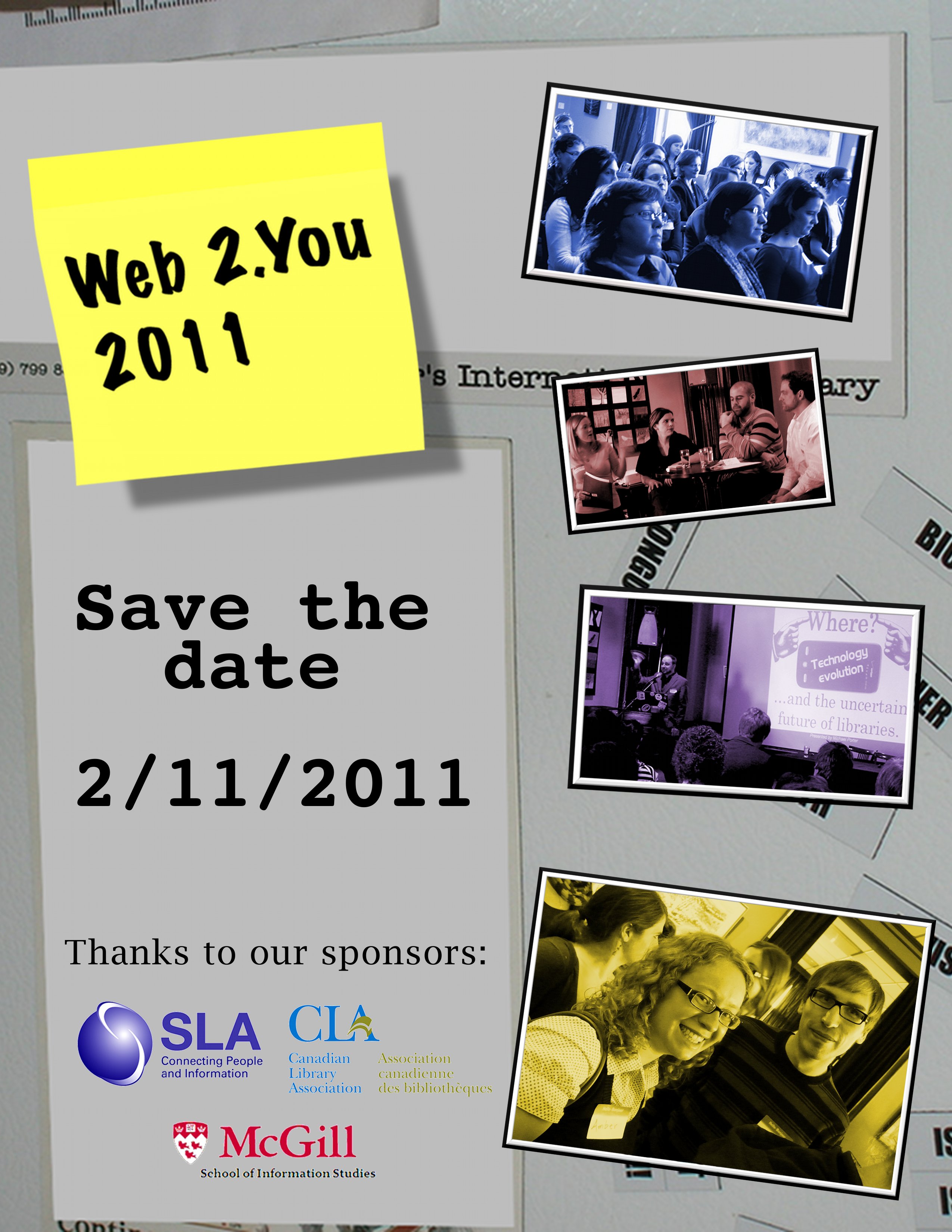
I attended the 4th annual Web 2.You conference yesterday, and it did not disappoint. As you may know, I was co-organizer of Web 2.You 2009 and last year I was a presenter, but this time I was perfectly happy to sit and simply enjoy the day. The only small role I played was ambushing Web 2.You co-founder Amy Buckland at the opening by presenting her with the SLA Eastern Canada Chapter 2010 Member of the Year award. After that, there were no more surprises, just the high quality presentations we’ve come to expect each year.

Joanne Mayhew kicked things off with a presentation about Industry Canada‘s corporate wiki. The project has really taken off, and if they had only started a year earlier, I might have been able to have been involved with it when I worked there in the summer of 2008. At any rate, it was an interesting look at a successful wiki launch, and I have no doubt it will be useful for anyone in the audience who might work on a similar project in the future.

Next up, Rajiv Johal and Michelle Lake talked about LinkedIn, which is one of those social sites on which many people create profiles but fail to maintain them after the first month or two. I have the feeling that when the audience went home last night, we all either signed up for the site or updated our profiles. It was especially interesting for me because I gave a presentation on LinkedIn for MBA students last semester, and Rajiv and Michelle covered some angles I hadn’t considered before. I had looked at the site mainly in terms of networking and job hunting, but Rajiv pointed out that it can be a powerful tool for business librarians doing research on small companies. I definitely picked up some tips that I will be able to use in the future.

After lunch, we heard from a panel made up of Ulla de Stricker, Robin Canuel, and Carolyn Hank. For a group of people who had never met in person before, they did a remarkable job of feeding off of each other’s enthusiasm while maintaining a smooth flow of conversation. Topics included the ownership of tweets, data loss through reliance on USB sticks, and the belief of some students that all important old research has already been digitized. If the audience didn’t already have enough ideas to occupy our thoughts, we certainly had plenty to ponder after watching the panel discussion.

Jason Puckett wrapped things up with a fascinating look at “open formats, open source, open access, and open publishing.” He demonstrated the importance of openness to libraries, pointing to examples of where closed formats limit our users; for example, DRM on music and DVDs may actually encourage piracy because the pirated version is more useful. After pointing out the flaws in our current electronic environment, Jason gave examples of content creators, like Cory Doctorow, who are finding creative new business models that allow for openness and profits to coexist. He concluded on an optimistic note, suggesting that librarians are in a position to influence vendors and demand that they provide their information in open formats.

As usual, the event was followed by a 5 à 7, where the audience was able to interact with speakers (and perhaps to ask the questions we hadn’t been brave enough to ask in front of the whole group). All in all, it was a terrific day – congratulations to the organizers, MLIS students Adrienne Smith and Bruno Therrien!

NPR review of OverDrive

As a follow up to my last post, I just wanted to point out that NPR recently wrote about libraries lending ebooks (and specifically through OverDrive). The article is written from a public library point of view, which partly explains why it’s less favourable than my assessment; people don’t come to academic libraries looking for the latest best sellers, so you don’t see 100 people waiting in line for a book (students do sometimes wait around for popular books, but these tend to be their required textbooks). However, I can’t deny that having to download multiple pieces of software and having to set up multiple accounts is a bit of a hassle, especially for people who are not technologically inclined (then again, these people probably don’t want to read books on their phones, at least for now). Check out the full article here:

Review: Library E-Books Easier, But Still Hassle (via LISNews)

Why I’m finally digging OverDrive

Don’t get me wrong – OverDrive has always been a very cool idea, but now it’s appealing to me in a more concrete way. Let me start at the beginning.

OverDrive is a service that allows libraries to “lend” ebooks, audio books, music and video files, and other digital content. Clients can download these items and use them for a set period of time (usually a week or two), at the end of which the files will automatically delete themselves (well, technically they disable themselves). Like with physical items, if one client has “checked out” a file, no one else can access it until it is automatically “returned” at the end of the loan period (unless the library purchases multiple copies, which of course also mirrors the lending of physical items). Files can be downloaded onto any computer running Windows or Mac OS.

The McGill Library has offered OverDrive for a couple of years now, so I’m reasonably familiar with the service. The idea fascinated me from the beginning, but I never made any personal use of it, even though McGill offers lots of great content, from popular fiction to language learning materials to travel guides. Here’s why I didn’t get into it at first:

  • I’m not interested in audio books; I’m much more of a textual and visual learner.
  • I’m satisfied with my regular sources for music and video files.
  • I don’t want to read a whole ebook on my computer.

That last point is the key. Although as a student (and now in my work) I preferred to read articles and even ebook chapters on my laptop, I can’t see myself doing that for reading not related to school or work. Of course, many OverDrive items can be transferred to ebook readers, so I could borrow a Sony Reader and read my ebook on there, but then I would have to check the device out, plug it into my computer, and remember to return it on time. Maybe that doesn’t sound so bad (indeed, I’m glad plenty of our clients make use of the service), but it was enough to make me stick to print books.

Fast forward to a couple of weeks ago, when I heard that OverDrive had released an app that would allow me to read certain ebooks on my Android phone. There had already been an app for listening to audio books, which I’d tried out and probably would have used if I’d been an audio book person, but now I could download ebooks straight to my phone and read them. No (other) computer required! No messy wires to transfer the files! I had no trouble at all downloading an ebook, opening it with the OverDrive app, and navigating the intuitive interface. The folks at OverDrive did a great job on the app, and I will definitely be making use of it.

The downside is that it only works for ebooks that are in the EPUB format; I’m unable to access the many OverDrive ebooks that are in PDF format. I’m crossing my fingers that OverDrive will either (a) find a way to make the app compatible with PDF ebooks, or (b) start offering the majority of their ebooks in EPUB format, but either way, I’m glad I’m finally digging OverDrive.

Have you tried OverDrive? Ever downloaded an ebook straight to your phone? Let me know in the comments.